Water and rain imagery
The Earthquake BirdWater and rain imagery gives Lucy Fly and Teiji’s relationship its first atmosphere and its recurring language, but it never settles into a single meaning. Water is something Teiji tries to photograph in order to determine what is real; rain becomes a shared pleasure that draws the couple into the streets; and later, wet streets, railway sounds, and the click of a camera return as inseparable parts of Lucy’s grief. The images bind observation to intimacy and memory to uncertainty: what the camera preserves is visible, but never the whole truth.
Water as a Problem of Reality
Teiji’s fascination with water began in childhood. Growing up near Kagoshima, with Sakurajima visible in the distance, he received an old camera from his father on his first day of junior high school and photographed the volcano from different angles. Water became his other favorite subject. He would take off his shoes at the sea’s edge and photograph his toes through the rippling surface, expecting the image to show only the toes rather than the water around them. When the photographs were developed, he carried them back to the shore and compared each image with its subject. Sometimes he could not decide which was real. Taking more pictures promised an answer, but the need to keep comparing image and world meant that certainty remained out of reach.
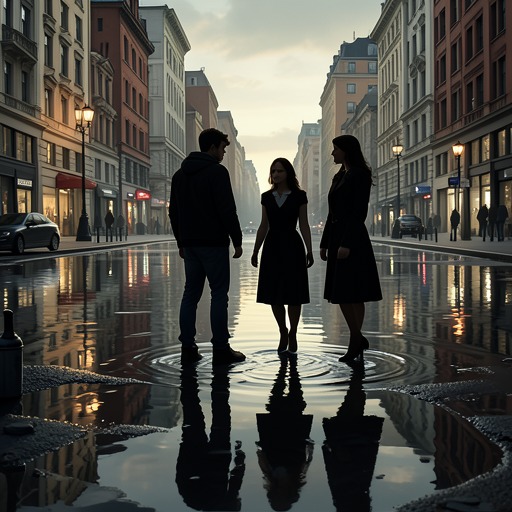
That childhood experiment reappears in Lucy’s account of meeting Teiji in Shinjuku. On a rainy night, he stands beside a puddle in front of the Keio Plaza Hotel, letting water run over his hair and face while he photographs. The puddle divides the hotel’s reflection: bright windows and lights occupy one side, darkness and cigarette butts the other. Lucy sees the cigarette ends as people jumping from the hotel, an image born of the distorted surface rather than anything the puddle establishes. Teiji, meanwhile, studies the water more intently than she can understand. The scene makes photography less a transparent record than a way of looking into an unstable surface, where the viewer’s own interpretation can enter the image.
Lucy steps into the puddle’s reflection, and Teiji photographs her feet against the hotel. He then raises the camera to look at her through its viewfinder and takes the first pictures of her, pictures she never sees. Water thus becomes the threshold of their encounter: Lucy enters the frame before she knows the photographer, and the reflected city makes their introduction an act of shared looking. The rain-soaked stranger seems to her made of water and ice, an impression that anticipates the language of their physical intimacy without turning him into something she can fully know.
Rain as Shared Language and Intimacy
In their life together, rain changes from the medium of Teiji’s solitary observations into a condition the couple seeks out. Lucy remembers whole weekends spent in bed, but says their favorite outings were warm nights in the rain. Teiji teaches her Japanese adverbs for different kinds of rainfall: potsu potsu for fine, spitting rain and zaa zaa for a downpour. These words give the weather a shared vocabulary, while the recurring rainy season in Lucy’s memories makes separate nights run together. Her recollection is affectionate but expressly uncertain about sequence: the nights have become jumbled, and she may be confusing them.
One remembered outing begins with Teiji pulling Lucy out of the room because it is raining and they cannot stay indoors. They splash through puddles in bare feet, moving from bright, crowded roads to a smaller street where individual drops can be heard landing on leaves, windowsills, and flower petals. The change of scale matters: traffic and umbrellas make the main highway a press of people, while the quieter street allows rain to be heard one drop at a time. Water is no longer only something framed by Teiji’s camera; it surrounds both bodies and gives their movement a rhythm.
At a railway bridge, they wait beneath the Yamanote and Chuo lines for a train to pass overhead. The interval is short, about three minutes, and the train’s passage becomes part of the scene’s beat: they kiss against the concrete, then make love as another train crosses above them. Rainwater squeezes from their T-shirts, while the rough wall leaves pink and white lines on Lucy’s back and catches at her hair. The remembered scene joins tenderness and bodily discomfort to the city’s machinery. The railway and the weather are not distant scenery; they enter the lovers’ physical experience, making the place itself part of what Lucy later remembers.
The Camera, the Body, and the Watery Image
The first night with Teiji carries the same tension between being seen and being known. After their walk from the Keio Plaza Hotel to his apartment in Shin-Okubo, he takes a final photograph of Lucy’s naked body. She does not mind being viewed through the camera, which seems kinder to her than the naked eye because it cannot blink or sneer while the picture is being taken. The camera’s judgment is deferred until the film is developed. Like the puddle’s reflection, the photograph promises to hold an image while leaving its meaning unsettled; unlike the rain, it can preserve a moment beyond the encounter.
Afterward, Teiji closes his eyes. Lucy imagines that he is watching the still image of her beneath his eyelids, and describes their sex through the contrast of his ice body and the water into which it seems to melt. The metaphor joins the visual and the tactile: the man first seen as an icy figure in the rain becomes, in Lucy’s account, a body altered by contact. Her description is explicitly shaped by her own perception, not offered as an objective explanation of Teiji. Throughout the novel’s water imagery, the boundary between what is seen and what is felt remains porous.
Sound, Loss, and the Return of Rain
Rain’s shared language continues to echo after the relationship has become a source of pain. Lucy later stands beneath railway bridges and makes herself shiver when a train passes, seeking the sensation of the nights with Teiji. The scene cannot restore him: she weeps because his smile and body are absent, and her sobs return from the bridge as echoes. The earlier combination of rain, railway, and touch has been reversed. The bridge remains, but instead of sheltering an intimate encounter, it amplifies Lucy’s awareness of loss; she cries for Lily as well as for Teiji.
The earthquake bird extends this pattern of uncertain listening. Lucy and Teiji have heard a distant noise during earthquakes, which Teiji thinks may be a bird dislodged by the tremor. Lucy also wonders whether the sound begins just before the ground moves. She cannot establish whether it is a warning, a symptom, or a mistake in perception; by the time she is alert enough to concentrate, it has stopped. The sound’s ambiguity resembles the water in Teiji’s childhood photographs: attention intensifies the question but does not guarantee an answer. In a later home, the train rattles past and shakes the buildings, making it easy to miss other movements beneath the earth. Familiar urban noise can mask the more threatening tremor, just as a sound heard in the night can be difficult to locate or explain.
Near the end, a rustling in the trees and the unmistakable click of a camera, followed by the whirr of film advancing, bring Teiji back to Lucy’s attention without confirming his presence. She looks for him but sees only trees and bushes; the clicking seems to echo in every direction. Rain begins as distinct, hard drops on her skin, the leaves, and the balcony railing, then grows heavier. Its progression recalls the vocabulary Teiji taught her and the rainy nights they shared, but now the sound accompanies fear and the effort to remain indoors with the warmth of home and friends. Water and rain therefore do not resolve Lucy’s uncertainty or offer simple consolation. They carry the intimacy of the past into a present where the camera may be heard, the beloved may be absent, and the old sensations are difficult to leave outside.